


The Roadmap to Capability Flow.
The Diagnostic Truth
Most organizations treat L&D as a cost center because they are stuck in the early stages of maturity. Growth isn't about adding more courses; it’s about evolving the system.
This framework is the clinical diagnostic used to identify where your system is hemorrhaging value—and what must be true to stop the bleed.
Expertise Snapshot
Stages of Maturity
A maturity framework for sustained success—so you know where you are, what’s holding you back, and what must be true to progress.
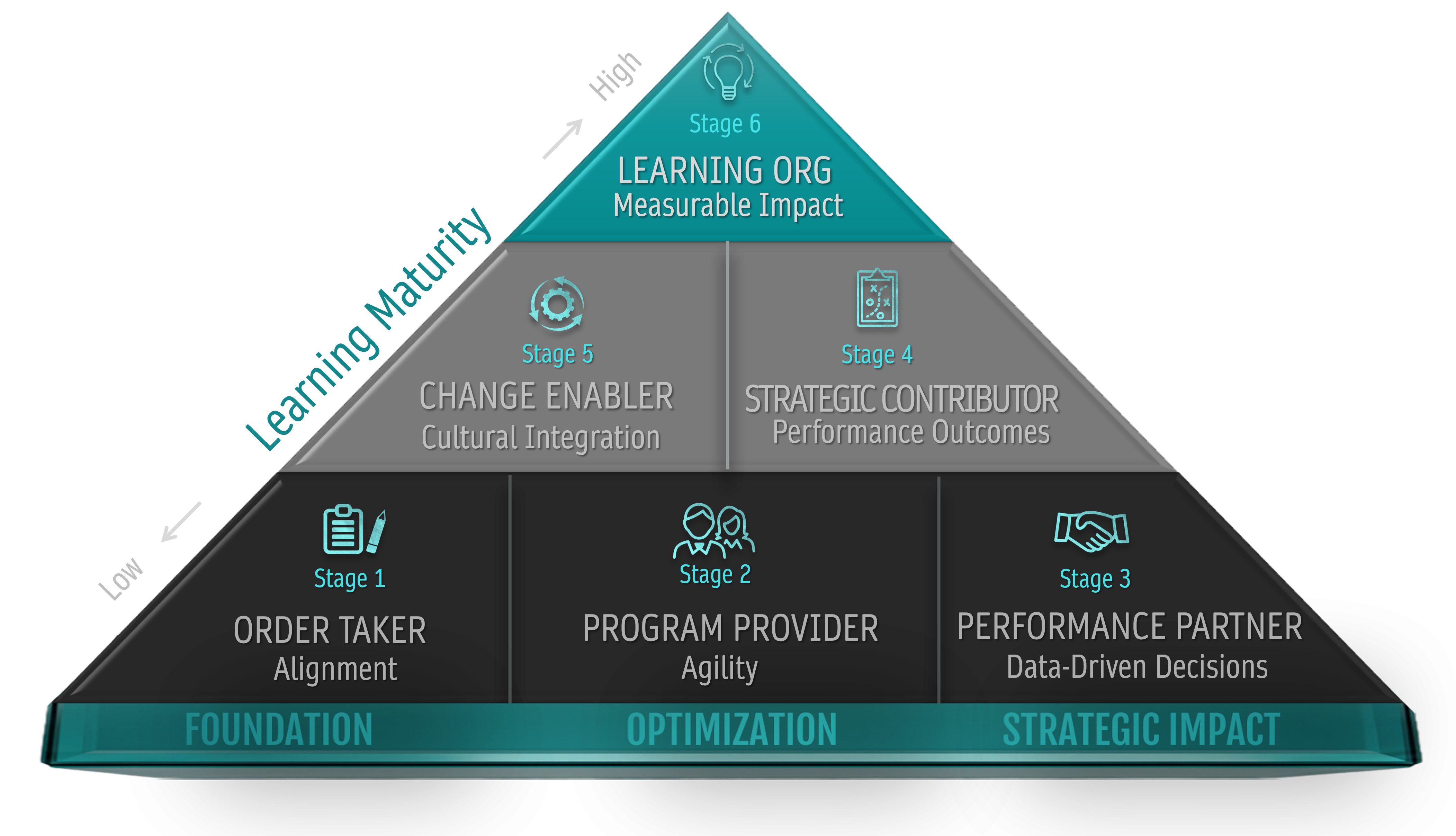
Order Taker (Reactive)
Characterized by reactive intake, activity-based metrics, and a total lack of alignment with business KPIs.
Program Provider
Focused on reliable delivery and high-volume output, but still lacks a direct linkage to performance outcomes.
Performance Partner
The pivot point. Here, L&D begins diagnosing performance gaps and designing solutions tied directly to work tasks.
Strategic Contributor
Learning is fully aligned with corporate strategy. Governance standards and operational cadences are established.
Change Enabler
L&D drives organizational readiness. It is integrated into the business as a primary vehicle for change and risk reduction.
Independent Learning Org
The gold standard. A scalable, measurable engine where learning outcomes are indistinguishable from business results.
THE DIAGNOSTIC VALUE OF THE 6 STAGES
Why Most Learning Teams Stall—Even When They’re “Doing Everything Right”
Progress doesn’t stall because teams stop working. It stalls because the system hasn’t evolved to support the next level of performance.
The Content Trap
Symptom: Growing libraries, increasing effort, little change in performance.
Root Cause: Learning activity is mistaken for progress, with no disciplined analysis of performance gaps.
Fix: Shift from content creation to targeted gap analysis that ties learning directly to capability and outcomes.
The Governance Gap
Symptom: Strong relationships, inconsistent execution, and uneven trust from leadership.
Root Cause: Learning operates on goodwill instead of clear standards, decision rights, and operating rhythms.
Fix: Establish governance models that formalize how learning prioritizes, delivers, and measures work at scale.
The Accountability Gap
Symptom: High completion, positive feedback, limited evidence of business impact.
Root Cause: Success is measured by activity metrics instead of performance movement and organizational results.
Fix: Redefine success using outcome-based measures that leaders trust and act on.
The Methodology: Lean-Driven Maturity
The 6 Stages is a universal pathway—from audit to results.
The 6 Stages of L&D Growth gives leaders a clear way to identify where learning is today, what’s preventing progress, and what must be true to evolve the system—without relying on trends, personalities, or industry-specific jargon.
It works because maturity has predictable patterns across sectors: how priorities are set, how work flows, how decisions are governed, and how results are measured. That’s why the framework applies in finance, healthcare, retail, manufacturing, technology, and government— anywhere capability drives performance.
Lean Six Sigma is the discipline behind the pathway—ensuring each stage is measurable and sustainable. And the 6 Stages Scorecard provides the evidence mechanism: a simple, repeatable way to track progression, prove continuous growth, and protect long-term performance.
How to Use the 6 Stages
A fast way to diagnose your current maturity, identify what’s stalling progress, and choose the next move.
► Step 1:
Locate Your Stage
Identify where your team behaves most often—not what you *aspire* to be. The stage is defined by how decisions are made, not how busy the team is.
► Step 2:
Name the Stall Point
Use the Stall Points section to identify whether you’re trapped by content volume, weak governance, or metrics without accountability.
► Step 3:
Define “What Must Be True”
Progress requires operating conditions—decision rights, workflows, measures, and stakeholder alignment—not motivational speeches or more content.
► Step 4:
Build the Next System
Use Lean-Driven Maturity to implement the next-stage infrastructure: intake, prioritization, governance, measurement, and scalable delivery.
Executives use this to stop guessing, align learning to performance, and move maturity forward with proof.